
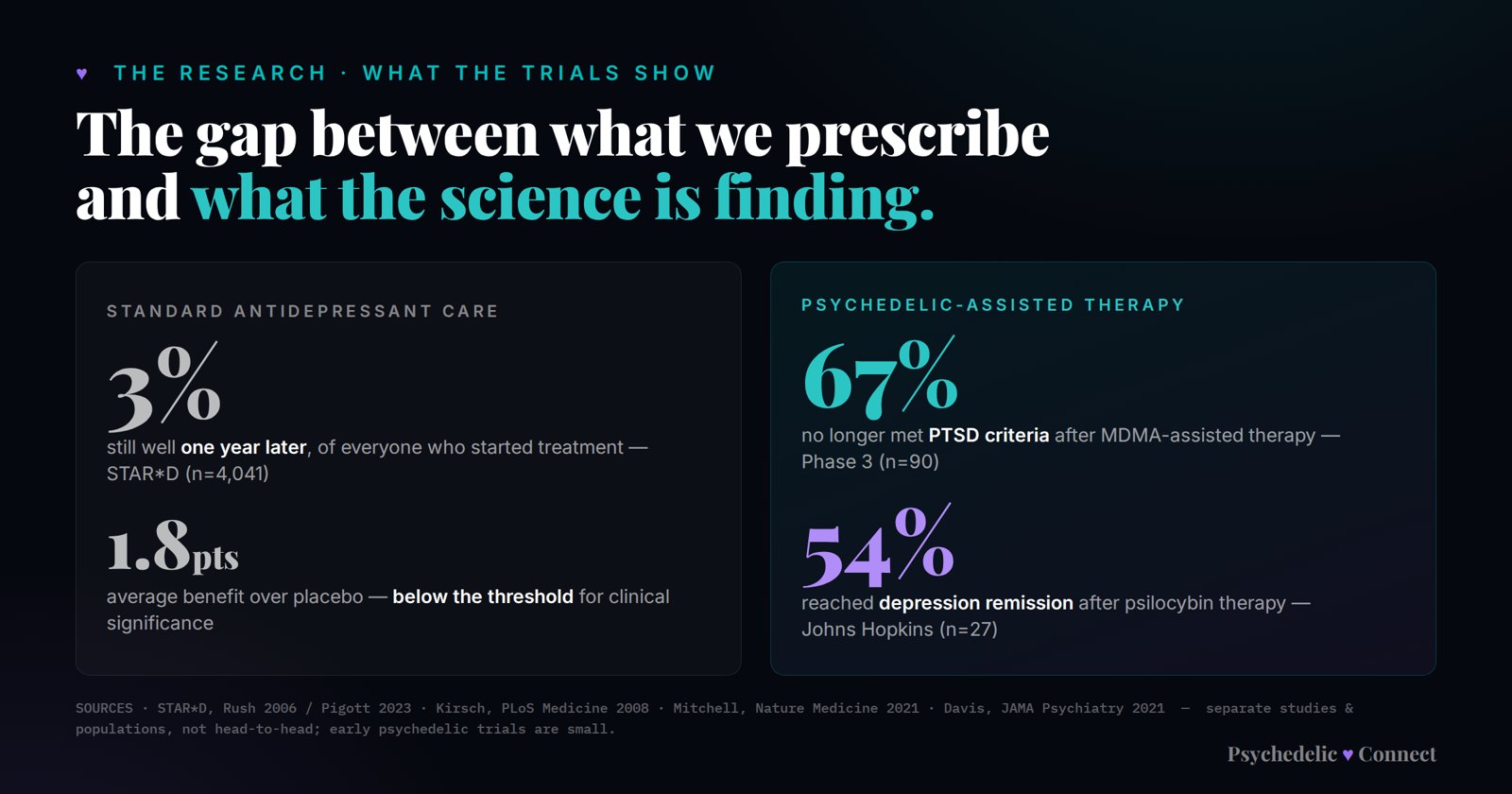
Here is a number that should be on the front page of every health section in America, and almost never is. In STAR*D — the largest, longest, government-funded study of antidepressants ever conducted — researchers followed 4,041 real patients through medication after medication, doing everything the standard playbook prescribes. After a year, the share who had gotten well and stayed well was about three percent.
Three. Not thirty. Not thirteen. Three.
That figure deserves a careful reading, because the honest version is actually more damning than the careless one, and we’re going to be precise about it throughout. It does not mean only 3% of people ever felt better — many did, at least for a while. It means that of everyone who walked in the door, only about 3% reached full remission and were still there twelve months later, without relapsing or dropping out. People climbed out of the hole. Then, over and over, they slid back in.
Nearly 30 million American adults are taking these medications right now. A great many are being helped, and nothing here is an argument to stop taking anything. But a very large group is doing everything right and still not getting all the way better — and they have rarely been told how common their experience is, or why. This is an editorial about that gap: how big it is, how it stayed quiet, and what the research is finally pointing toward.
First, the number everyone misreads
The distinction between “felt better once” and “stayed well” is the whole story, so it’s worth slowing down. In the research, three words that we use interchangeably in daily life mean very different things — and the drop-off between them is brutal.
What is the antidepressant gap?
The distance between what patients are told and what the evidence shows: in STAR*D, the largest antidepressant study ever run, only about a third of patients reached remission on a first medication and many relapsed within a year. That gap is why psychedelic research for depression is being taken seriously.
A lot of people get here. Antidepressants can genuinely take the edge off — and for many, that relief is real and worth having.
Fewer make it this far. In STAR*D, about 37% reached remission after their first medication — roughly one in three.
This is where it collapses. Of everyone who started, only about 3% were still well a year later without relapsing or dropping out.
So the real indictment isn’t that antidepressants never work. It’s that the improvement so often doesn’t last — and that the standard of care has quietly accepted a revolving door of switching, relapsing, and switching again as normal. If that cycle sounds like your life or someone you love’s, the data says you have a great deal of company.
How weak the evidence really is
STAR*D measured staying well. A separate body of research asks the blunter question: how far do antidepressants beat a sugar pill at all? And here the story turns from disappointing to genuinely uncomfortable — because the answer depends entirely on which trials you’re allowed to see.
In 2008, a team led by Erick Turner published a study in the New England Journal of Medicine that should have changed the conversation permanently. They pulled the complete set of antidepressant trials registered with the FDA — including the ones the public never saw. In the published medical literature, 94% of trials appeared positive. In the FDA’s full record, only 51% were. Nearly a third of all trials, representing about 3,449 patients, were simply never published. Several negative studies that did appear were written up to read as wins.
How large is the real effect once you count everything? A landmark meta-analysis by Irving Kirsch pooled the complete FDA dataset and found an average improvement of just 1.8 points on the Hamilton depression scale over placebo — below the 3-point threshold the UK’s guideline body considers clinically meaningful. The drug only cleared that bar for the most severely depressed patients, and even then, the authors concluded, it was because placebo stopped working in severe cases — not because the medication worked better.
Follow the incentives, not the conspiracy
It is tempting to reach for a villain here, and we won’t, because the truth is both more mundane and more powerful than a conspiracy. You don’t need anyone to be evil for this outcome. You just need the incentives pointing the way they point.
Consider the economics honestly. A medication a patient takes every day, potentially for decades, is one of the most valuable products a company can own — a protected molecule, a renewable prescription, a revenue stream that refills itself every month. A treatment a person undergoes a handful of times and then may not need again is, by that same logic, a far worse business. And a medicine that grows in the ground — a mushroom, a shrub’s root bark — can’t be patented the way a novel compound can, which means no one has a billion-dollar reason to fund the trials that would prove it works.
The Daily-Pill Model
Taken: every day, often for years or indefinitely.
Business logic: a patentable molecule and a recurring monthly prescription — revenue that renews itself.
Research funding: abundant. Thousands of industry-sponsored trials.
Publication: positive results reliably reach print; negative ones, per the FDA record, often did not.
The Few-Sessions Model
Taken: a small number of supervised sessions paired with therapy.
Business logic: plant-derived compounds that are hard to patent — little recurring revenue to capture.
Research funding: historically scarce; much of it philanthropic or academic, not industry.
Goal: lasting change after the medicine is gone — not indefinite management.
None of that makes antidepressants bad medicine, and it doesn’t make a mushroom magic. “Natural” is not a synonym for “safe” or “effective” — ibogaine in particular carries real cardiac risk and demands medical supervision. But it does explain something that otherwise looks baffling: why the most-prescribed treatment for one of the most common conditions in the country rests on a thinner evidence base than patients assume, while a genuinely promising alternative spent decades starved of the funding that would let it prove itself. The gap isn’t a scandal of villains. It’s a scandal of incentives — and the people who pay for it are the ones on their fourth medication, wondering what’s wrong with them.
What the science is finally finding
For all that missing funding, the research that did get done is hard to ignore. Over the last decade, teams at Johns Hopkins, NYU, Stanford, and Imperial College London have tested whether psychedelic-assisted therapy can reach the people conventional care leaves behind. The early results earned the field FDA Breakthrough Therapy designations and Phase 3 trials — and they look nothing like a 1.8-point edge.
Why a few sessions might outlast a daily pill
The mechanism is still being worked out, and we won’t overstate it. But it points at why the two models diverge. Antidepressants are taken continuously to manage symptoms. The psychedelic model under study aims instead to produce change that persists after the medicine clears — and researchers point to measurable spikes in neuroplasticity, the brain’s capacity to rewire itself, as one candidate explanation. It reframes the entire question. Not “which pill do you take forever?” but “can a guided experience help the brain reset?”
Where this leaves you
If you or someone you love has worked through medication after medication and still feels stuck, hold two truths at once. First: that experience is common, it is documented, and it is not a personal failing — the numbers above are the proof. Second: the alternatives now being studied are genuinely promising but still emerging, carry real medical and legal weight, and are not right for everyone. Ibogaine and 5-MeO-DMT in particular require careful medical screening, including cardiac evaluation, and should only ever be approached in a properly supervised setting.
That combination — real hope, real complexity — is exactly why guidance matters. Knowing what the research actually says is the first step. Knowing which providers genuinely meet a credible medical standard is the next one.
Not sure where to start?
Speak with an advisor who understands both the research and the landscape — and who has been through it. Confidential guidance, with no pressure and no obligation.
Speak With An Advisor
or call (866) 435-7057
Sources
- Rush AJ, et al. “Acute and longer-term outcomes in depressed outpatients requiring one or several treatment steps: a STAR*D report.” American Journal of Psychiatry, 2006. (n=4,041)
- Pigott HE, et al. “A reanalysis of the STAR*D study’s patient-level data.” BMJ Open, 2023.
- CDC/NCHS. “Prescription Medication Use for Depression: United States, 2023.” NCHS Data Brief No. 528, 2025. (11.4% of adults)
- Turner EH, et al. “Selective Publication of Antidepressant Trials and Its Influence on Apparent Efficacy.” New England Journal of Medicine, 2008.
- Kirsch I, et al. “Initial Severity and Antidepressant Benefits: A Meta-Analysis of Data Submitted to the FDA.” PLoS Medicine, 2008.
- Cipriani A, et al. “Comparative efficacy and acceptability of 21 antidepressant drugs…” The Lancet, 2018. (522 trials; 116,477 participants)
- Mitchell JM, et al. “MDMA-assisted therapy for severe PTSD: a randomized, phase 3 study.” Nature Medicine, 2021. (n=90)
- Davis AK, et al. “Effects of Psilocybin-Assisted Therapy on Major Depressive Disorder.” JAMA Psychiatry, 2021. (n=27)
- Johnson MW, Garcia-Romeu A, et al. “Psilocybin in the treatment of tobacco addiction.” Journal of Psychopharmacology, 2014. (n=15)